AI factories explained: Building, deploying and improving AI at scale  

While a traditional ‘factory’ describes the transformation of raw materials into tangible goods, an AI factory functions in a fundamentally different way. It’s an approach to running AI at scale by building, deploying, and improving it. AI factories turn data into insights through an iterative lifecycle, from development to deployment and ongoing optimization. They also provide and fine-tune intelligence to drive business decisions and revenue at scale.  

According to IBM, 42 per cent of enterprise-scale companies with more than 1,000 employees report having actively deployed AI in their business. The shift signals a broader transformation in how businesses create value, with AI emerging as a new production system for the digital economy. 

Telehouse Canada sees this development as reinforcing the critical role of modern data centres in enabling organizations to access specialized, AI‑ready infrastructure essential for supporting data‑intensive workloads and ensuring AI factories run efficiently and reliably. 

What are the components of an AI factory? 

An AI factory uses a data pipeline to collect and clean raw data for AI models to use. Data must be organized and cleaned so that AI models can generate accurate predictions and recommendations.  

Through algorithm development and training, data is turned into insights. Trained models process the large datasets to generate predictions in real-time. Depending on the use case, models may be designed to forecast behaviour, optimize operations, or identify patterns to inform decision-making. Over time, inference outputs feed back into the system to improve accuracy and automation.  

Additionally, AI factories require compute infrastructure to support the pipeline. Examples of hardware include GPUs, CPUs, storage, networking, and cooling systems, while software components are modular and API-driven. AI factories also enable testing and experimentation, including through digital twins that simulate and optimize systems before deployment.  

The data can then be aggregated across systems into a single simulation where teams can test designs and redundancy in real time. The insights during this experimentation feed back into the system and improve data quality over time, creating an ongoing iterative process to improve model accuracy. 

Use cases for AI factories 

Leveraging AI is essential for businesses to continue to scale in our ever-changing digital world. Integrating AI into business operations helps automate processes and allows for more informed, real-time decision-making that meaningfully impacts customers.  

According to Harvard Business Review, many corporations utilize AI factories, including Google, to power their daily ad auctions and Uber to determine ride availability. These systems are already powering critical, real-time decisions at scale across industries. For industries such as healthcare or finance, regulations can make it challenging to host sensitive datasets in public clouds. In these cases, AI factories deployed in private or hybrid environments allow organizations to maintain greater control over sensitive data. 

How do you know if you have the data infrastructure to feed an AI factory? 

Data centres are the backbone for AI 

An AI factory is the production system for AI, while data centres provide the foundation that enables it to operate at scale. Supporting an AI factory requires access to clean, reliable data, infrastructure that supports hybrid and distributed environments, and proper governance, security protocols, and compliance. An AI factory cannot operate without a data centre.  

Cooling solutions 

AI training generates heat at a greater magnitude than traditional workloads, making conventional air cooling insufficient. Instead, liquid cooling, such as direct-to-chip, offers a more efficient and reliable solution due to its higher thermal conductivity.  

Telehouse Canada recently introduced a major infrastructure upgrade designed to bring compute closer to end users to accelerate service delivery and achieve low-latency performance. This upgrade includes the introduction of a direct liquid-to-chip technology, marking a first-of-its-kind deployment, delivered in collaboration with Enwave to enable sustainable cooling.  

While these capabilities are often limited to large-scale facilities outside major urban centres, Telehouse enables high-density AI deployments within a metro environment, maintaining low-latency connectivity and proximity to end users. Through this process, Telehouse Canada removes up to 80 per cent of heat directly from high-power server components. As a result, this reduces reliance on power-intensive computer room air conditioners (CRACs) and server fans, lowering overall energy consumption. 

The emergence of AI factories highlights the essential need to not only foster innovation but to improve decision-making for businesses. As AI becomes a core production system, we can expect to see enterprises redefine how they operate and data centres becoming increasingly important to house this infrastructure. Telehouse’s direct liquid-to-chip cooling technology, combined with its dense interconnection ecosystem and low-latency connectivity capabilities, will play an important role in helping organizations scale AI infrastructure efficiently and sustainably.  

Beyond this, our geographic location, dense interconnection ecosystem and broad access to networks and cloud providers enable us to scale efficiently, extend reach, and deliver low-latency services closer to end users. Our connectivity capabilities will continue to deliver above and beyond the performance and reliability our customers need. To learn more about our new technology, read our recent press release here

Telehouse Canada undergoes major infrastructure upgrade to scale AI-driven organizations

With the introduction of direct liquid cooling, this first‑of‑its‑kind deployment within urban, interconnection‑rich data centre campuses in Canada establishes a new standard for enabling AI workloads. 

TORONTO, ON – May 12, 2026 –Telehouse Canada, a leading data centre service provider and subsidiary of KDDI Corporation, has announced the completion of a major infrastructure upgrade designed to support the next generation of AI‑driven workloads. By introducing direct liquid‑to‑chip technology, Telehouse enables high‑density AI inference deployments within its interconnection‑rich downtown Toronto data centre environments—reinforcing the company’s leadership in delivering resilient, future‑ready facilities that power Canada’s digital transformation and support the next wave of innovation. 

As AI adoption accelerates across industries, organizations are increasingly seeking data centre environments capable of supporting performance‑intensive workloads at scale. These requirements are driving demand for higher‑density infrastructure and advanced cooling solutions, particularly in environments where reliability, efficiency, and proximity to end users are critical for AI inference. 

Building on this investment, Telehouse Canada has deployed direct liquid cooling across its metro data centre campus, alongside infrastructure enhancements designed to enable high‑density deployments and improved connectivity for AI workloads. The deployment supports organizations colocating AI infrastructure within Telehouse facilities, with cabinet densities of up to 120 kW per rack. 

This marks a first-of-its-kind deployment of direct liquid cooling within an interconnection hub in Canada, underscoring its significance within the Canadian data centre and interconnection landscape. The upgrade positions Telehouse Canada to support organizations with strict cooling and power requirements while continuing to deliver low-latency connectivity and proximity to end users.  

“As demand for AI continues to grow, organizations need data centre infrastructure that can support increasingly complex workloads at scale,” said Atsushi Kubo, President and CEO of Telehouse Canada. “This upgrade strengthens our ability to meet those needs while continuing to deliver the performance and reliability our customers expect.” 

Advancing energy efficiency through heat recovery and reuse 

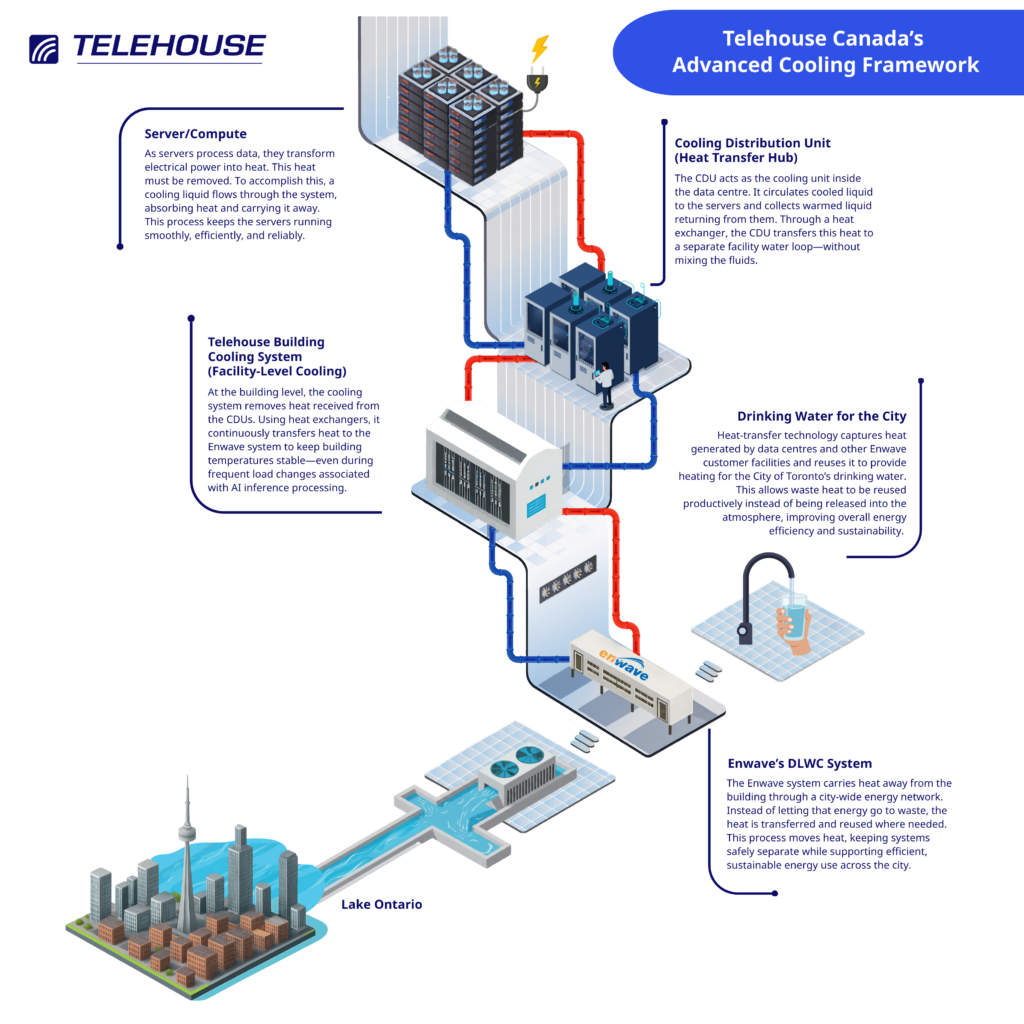
Liquid cooling is more thermally conductive than air, allowing Telehouse Canada to remove up to 80 per cent of heat directly from high-power server components. As a result, reliance on power-intensive computer room air conditioners and server fans is reduced, lowering overall energy consumption while delivering a more sustainable and efficient cooling model. The direct liquid cooling system transfers heat from the server components to a cooling distribution unit, where it is carried away via a dedicated coolant loop. This heat is then transferred to Enwave’s closed-loop district energy system, where it is captured and repurposed through a fully isolated process to help heat Toronto’s municipal drinking water rather than being released into the atmosphere, which improves Telehouse Canada’s Power Usage Effectiveness (PUE). In addition, the system removes reliance on chillers during normal operations, which reduces the need for evaporative cooling and reduces water usage, further improving the facility’s Water Usage Effectiveness (WUE).  

The project reflects Telehouse Canada’s continued focus on building resilient, high‑performance digital infrastructure while also delivering tangible sustainability and economic benefits, including local job creation and the engagement of approximately 80 skilled professionals across construction and engineering disciplines throughout the project lifecycle. 

Aligned with Canada’s focus on digital infrastructure, AI, and innovation, investments such as this play an important role in strengthening the country’s digital foundation—supporting long‑term growth, accelerating innovation, and ensuring infrastructure readiness as organizations scale AI‑driven operations. By continuing to invest in high‑performance, interconnection‑rich environments, Telehouse Canada is committed to enabling the next phase of digital transformation while supporting the evolving needs of Canada’s digital economy and helping businesses scale and compete globally. 

About Telehouse 

Telehouse is a leading global data centre service provider under KDDI Group, bringing together a diverse range of business partners including carriers, mobile and content providers, enterprises, cloud providers and financial services companies. Established in 1989, Telehouse provides reliable, secure, and flexible colocation services, enabling organizations to accelerate speed to market and create business opportunities through fast, efficient and secure interconnections. For more information visit: www.telehouse.ca 

Telehouse Canada media contact: 
Kristina Ivashkova 
Sales & Marketing 
[email protected] 

Everything You Need to Know About Neoclouds

As AI continues to be deployed across industries, enterprises are struggling to keep up with the growing demands of compute power and infrastructure. According to Mckinsey & Company, data centre infrastructure spending is expected to exceed $1.7 trillion, driven in part by increasing AI demand. The training and inference workload demand worldwide is expected to reach 200 GW by 2030.

At the same time, the cloud computing landscape is evolving. While traditional cloud platforms have long dominated the market, a new category of infrastructure is emerging to address the unprecedented demands of artificial intelligence and high-performance computing workloads.

This shift has led to the rise of neoclouds, a new generation of infrastructure providers designed to support GPU-intensive and large-scale AI applications. As organizations increasingly deploy machine learning models, large language models, and GPU-intensive workloads, they’ve encountered limitations in traditional cloud architectures that were designed for different use cases, driving demand for more specialized solutions.

In fact, Cloud Syntrix reports that the recent industry surveys reveal that 25 per cent of enterprises are already using neoclouds, while 34 per cent are actively testing these platforms, reflecting broader changes across the data centre industry. At Telehouse Canada, we are seeing enterprises adopt hybrid approaches that combine traditional cloud services with neocloud platforms to support both conventional and emerging workloads.

What are Neoclouds?

Neoclouds, sometimes referred to as neo‑cloud providers or AI-first cloud providers, are a newer class of cloud infrastructure companies that focus on specialized, high‑performance, and cost‑efficient cloud services. Unlike traditional cloud providers that offer general-purpose computing resources, neocloud vendors are designed specifically to support GPU-intensive applications such as machine learning, large language models, and real-time inference. These platforms provide access to advanced GPU infrastructure, high-bandwidth networking, and architectures optimized for distributed computing, enabling organizations to process large datasets and train models more efficiently.

For enterprises evaluating their infrastructure options, neoclouds represent a strategic option for compute-intensive workloads, where performance, scalability, and speed are critical. Rather than replacing traditional cloud services, they are often used alongside them as part of a broader hybrid infrastructure approach, supported by carrier-neutral colocation environments that enable direct connectivity between platforms.

How Do They Work?

Neocloud providers purchase clusters of GPUs from companies and install them into specialized data centres. Companies can then rent GPU compute capacity from neocloud providers without needing to purchase and maintain the hardware themselves. In practice, this works like on-demand access to specialized infrastructure to speed up training or run large AI models in real time. Neocloud platforms are also designed for rapid provisioning, allowing organizations to access GPU resources quickly and deploy workloads without managing the underlying infrastructure. These services can be extremely powerful for simulations, robotics, and autonomous systems, as well. Some of the leading neocloud providers include CoreWeave, Nebius, and Vultr, to name a few.

Neoclouds operate on infrastructure specifically engineered for GPU-intensive computing. These environments rely on high-density racks equipped with the latest GPU accelerators—such as NVIDIA or AMD—supported by specialized power delivery systems and cooling technologies, such as liquid cooling, designed to handle high-performance AI workloads.

The networking layer in neocloud environments is equally important. High-bandwidth, low-latency connectivity enables efficient communication between GPU nodes during distributed AI workloads, where data transfer and synchronization can impact performance. Carrier-neutral data centres support this through direct, low-latency connections to cloud platforms, Internet exchanges, and other networks.

The Benefits of Neoclouds

The primary advantage of neoclouds is their performance optimization for AI and machine learning workloads. Organizations can benefit from faster training times, reduced inference latency, and more efficient use of compute resources compared to general-purpose cloud platforms. This enables faster development cycles and more advanced AI applications.

Companies can avoid upfront capital costs by renting Graphic Processing Units as a Service (GPUaaS) rather than buying the AI infrastructure themselves. This allows organizations to access and scale GPU capacity on demand without managing physical infrastructure. Pricing models are typically flexible, allowing companies to pay per hour, per GPU, or through reserved capacity. While on-demand pricing for GPU instances on traditional cloud platforms can be expensive, neocloud providers often offer more competitive pricing models specifically tailored to AI use cases. Cloud Syntrix notes that 33 per cent of enterprises face a 2-4 week wait time for GPU access from traditional cloud providers, highlighting the growing demand for more accessible AI infrastructure.

Neoclouds provide access to cutting-edge GPU technology with shorter adoption cycles, enabling faster experimentation and performance improvement. This is complemented by hybrid infrastructure strategies, where organizations combine neocloud platforms with traditional cloud services and on-premises systems.

Carrier-netural colocation facilities, like those operated by Telehouse Canada, support this approach by enabling direct interconnection between these environments. This allows organizations to build integrated infrastructure that can address latency requirements, data residency considerations, and diverse workload needs.

Why Choose Traditional Infrastructure if Neoclouds Exist?

Despite the impressive capabilities of neoclouds, traditional infrastructure remains essential for most enterprise workloads. General-purpose cloud platforms excel at supporting diverse range of applications, offering mature ecosystems of services that extend far beyond raw compute—including managed databases, serverless computing, comprehensive security services, and sophisticated orchestration tools. For organizations running conventional web applications, business intelligence platforms, ERP systems, or standard containerized microservices, they provide the right balance of functionality, scalability, and ease of management.

Regulatory compliance and data residency requirements also influence infrastructure decisions, particularly in industries such as financial services, healthcare, and government. These sectors often require greater control, security, and compliance, making colocation and hybrid models an important part of their infrastructure strategy. At Telehouse Canada, our infrastructure supports organizations meeting requirements for SOC 2 Type II, ISO/IEC 27001:2022, PCI DSS, GDPR, PIPEDA, and CCPA compliance—standards that ensure data handling meets regulatory obligations while maintaining the flexibility to integrate with both traditional cloud and neocloud platforms as workload requirements dictate.

In practice, most enterprises operate across diverse workloads that require different infrastructure approaches. Legacy applications, real-time trading systems, content delivery networks, and customer-facing web services all have distinct requirements that traditional infrastructure addresses effectively. The optimal strategy isn’t choosing between neoclouds and traditional infrastructure—it’s architecting a hybrid environment that leverages each platform’s strengths. Carrier-neutral colocation plays a key role in this approach, enabling direct connectivity between platforms and supporting a more integrated, flexible architecture.

Opportunities for Colocation and Data Centre Operators to Collaborate with Neocloud Vendors

Colocation and data centre operators play a strategic role in the neocloud ecosystem, providing the infrastructure required to support high-density GPU deployments, advanced cooling systems, and strong interconnection capabilities. As demand for AI workloads grows, neocloud providers increasingly rely on these environments to deploy and scale their platforms.

Data centre operators can attract neocloud providers by offering infrastructure specifically designed for AI workloads—including high rack power densities, liquid cooling readiness, diverse and redundant power feeds, and low latency networking capabilities. This creates a mutually beneficial relationship: neocloud providers gain rapid access to scalable, AI‑ready environments and establish a presence at the edge without the burden of building and operating dedicated facilities, while colocation operators strengthen their platform and appeal to enterprises pursuing hybrid and AI‑driven strategies—and seeking proximity to leading AI ecosystems.

As AI infrastructure expands, partnerships between neocloud providers and data centre operators are likely to become increasingly common.

Interconnection is a critical component of this model. Organizations running AI workloads require seamless connectivity between neocloud platforms, traditional cloud providers, on-premises systems, and partner networks. Carrier- and network -neutral data centres enable and facilitate this through direct access to Internet exchanges, network carriers, and public cloud on‑ramps via a simple cross‑connect setup, reducing complexity and improving performance. At Telehouse Canada, our interconnected Toronto data centres provide onsite access to a dense interconnection ecosystem of 200+ connectivity players, supporting distributed architectures and enabling organizations to run AI workloads efficiently while staying closely connected to their broader digital ecosystem.

Colocation facilities with strong regional presence, like Telehouse Canada’s Toronto locations, can serve as strategic nodes in distributed AI architectures—hosting neocloud infrastructure for latency-sensitive processing while maintaining connections to centralized training environments and traditional cloud services for comprehensive workload support.

What’s in Store for the Future of Neoclouds?

The emergence of neoclouds illustrates how rapidly the AI industry is evolving. As infrastructure moves beyond general purpose computing toward specialized services, innovation will increasingly depend on the availability and affordability of compute capacity. The industry can expect to see more partnerships between neocloud providers and data centre operators as the need for quick access to specialized infrastructure grows.

Advanced cooling technologies will also continue to grow to manage the heat and power demands of dense GPU clusters. Whether neoclouds will expand services beyond GPUs remains to be seen. However, one thing is clear: neoclouds are playing a growing role in expanding access to AI infrastructure.

Edge deployment represents a significant growth trajectory for neocloud infrastructure. As latency-sensitive AI applications proliferate—including autonomous systems, real-time video analysis, and industrial IoT—the need for distributed GPU computing at the edge becomes critical. This trend will drive neocloud vendors to deploy infrastructure in regional colocation facilities rather than concentrating resources in hyperscale locations.

Carrier‑ and network‑neutral data centres with strong regional connectivity and low‑latency access to major population centres and metro areas are emerging as strategic deployment points for edge‑oriented neocloud and AI services.

The combination of centralized training capabilities with distributed edge inference creates opportunities for comprehensive AI infrastructure strategies spanning multiple facility types and geographic locations.

As access to infrastructure expands, the facilities that support high-performance compute will become increasingly important. Telehouse Canada’s interconnected data centres provide the power, connectivity, and colocation environments needed to support dense GPU infrastructure and AI workloads.

Organizations exploring AI developments can contact Telehouse Canada to learn more about how our facilities support next-generation digital infrastructure: Contact Us | Telehouse Canada

Balancing AI Growth and Energy Demand: Key Takeaways from the Future of Data Centres Workshop

Andy Fenton, VP of Sales and Marketing at Telehouse Canada, and Alexander Ngai, Senior Manager of Business Planning  at Telehouse Canada, recently participated in the Future of Data Centres in the GTHA and Ontario workshop, hosted by MaRS and Mantle Climate. The session brought together leaders from across energy, infrastructure, and policy to explore one critical question: how Ontario can meet rapidly growing AI compute demand while managing its impact on energy systems. The goal was to inform policy development and guide future project investments by identifying practical next steps for sustainable data centre growth in Ontario.  

During the session we examined the barriers, opportunities, and system-wide impacts associated with each pathway. By creating collaboration between energy and digital infrastructure industries, we can better prioritize sustainable solutions. 

To quantify the strategies and discussions from the stakeholder engagement sessions, MaRS released its report, Sharing the load: A look into how the projected expansion  of AI infrastructure could strengthen  Ontario’s energy systems, which examines the range of factors that may influence whether AI infrastructure growth could strengthen or strain the province’s energy systems and communities. 

For our team, the report reinforced a central takeaway: the future of data centre growth in Ontario will depend on not just how much we build, but how we build it, and who we build it with. It’s clear that many stakeholders and policy makers are lacking direct interaction with key data centre users and owners. At Telehouse Canada, we will continue to play an active role in these conversations, but coordinated master planning across agencies, along with greater clarity in regulatory and permitting processes is needed. These workshops also highlighted that, with the right approach, this growth can serve as an opportunity to strengthen the broader energy system, not just add strain to it. 

The Growing Tension Between Energy Systems and AI Infrastructure 

There is no question that demand for AI infrastructure is accelerating. The federal government has signalled its goal to increase AI infrastructure development through both policy documents and funding programs as part of the 2025 budget’s Canadian sovereign AI Compute Strategy, and it’s clear why. AI compute power improves productivity in industries like manufacturing, healthcare, and transportation. Organizations that do not adopt AI risk falling behind in an increasingly competitive landscape. 

As the report highlights, access to AI infrastructure is quickly becoming as fundamental as access to energy or transportation networks. However, AI data centres are among the most energy consuming form of development we have seen to date, requiring large, continuous loads of electricity. The Independent Electricity System Operator (IESO) estimates an additional 5,000 megawatts are required to meet the growing need for electricity by 2035, underscoring the scale of the challenge. AI data centre growth for training and inference, combined with electrification across transportation, heating and industrial processes, is placing increasing pressure on the province’s available energy capacity.  

Turning a Challenge into an Opportunity: What Sustainable Data Centre Growth Looks Like in Practice 

Investing in infrastructure presents both a challenge and opportunity to help deliver compute power while building out a more resilient energy system.  A key focus of the workshops was identifying practical mitigation strategies that can reduce system impact while enabling continued growth. 

Collectively, stakeholders explored approaches such as waste heat recovery, energy storage, demand response, clean power purchase agreements (PPAs), low-carbon construction, and on-site generation, each contributing to a more sustainable and balanced energy system. 

Waste Heat Recovery: 

  • Waste heat recovery captures and repurposes excess heat generated by data centres, reducing overall energy waste. At Telehouse Canada, we leverage Enwave’s Deep Lake Water Cooling System (DLWC) to help redirect heat generated by our facilities to support the City of Toronto’s drinking water system. 

Energy Storage: 

  • Lithium-ion batteries and advanced energy storage technologies can support with load shifting and grid stability, particularly during peak demand periods. 

Demand Response: 

  • Demand response allows data centres to temporarily reduce power usage when called upon by utilities or grid operators, helping manage large, continuous loads more efficiently. 

Clean Power Purchase Agreements (PPAs): 

  • Power purchase agreements (PPAs) enable organizations to purchase renewable energy at a fixed price over a defined period, helping manage cost volatility while advancing sustainability goals. 

Low Carbon Construction: 

  • Emissions can be reduced at the construction stage through the use of sustainable materials and design strategies, including modular construction, efficient systems, and renewable energy integration. 

On-site Generation: 

  • On-site generation allows facilities to produce electricity directly, reducing reliance on the grid and helping alleviate strain during peak demand. 

While each of these strategies can deliver impact on its own, their effectiveness is strengthened when implemented together, highlighting the importance of coordination across the broader energy and infrastructure ecosystem. 

Why Coordination is Critical to Enabling Responsible Growth 

The workshops reinforced that technology alone is not enough to support sustainable data centre growth. Collaboration across developers, utilities, policymakers, data centre operators and communities will be critical. 

The report highlights the need for co-located infrastructure, where energy systems and data centres are planned together from the outset, something that has not yet been implemented at scale in Ontario. It also points to the importance of policy alignment, streamlined permitting, and shared planning frameworks to reduce friction. In practice, this means moving away from siloed decision-making toward a more integrated, system-wide approach. 

Looking ahead, leveraging policy tools is vital. The report highlights legislation such as Bill 40, Integrated Energy Plan for Generations, to fast-track initiatives that will improve sovereignty and deliver economic benefits whilst maintaining a clean, reliable and affordable system. The report demonstrates that pilot projects, including co-located data centre developments, are an essential way to test mitigation strategies in real-world environments. For example, impacts on grid reliability, community benefits, on-site generation, and more could help identify infrastructure constraints and inform future policy or practice. 

Just as importantly, these workshops emphasized the need for ongoing collaboration through provincial forums that bring together energy and digital infrastructure stakeholders. These forums could exist as advisory committees or working groups supported by the government. Once the province determines its priorities, a provincial forum can be established to enable co-located infrastructure.  By discussing evolving technology requirements, design standards, and market dynamics—and by proactively identifying emerging risks and opportunities—Telehouse Canada is positioned to contribute, through collaboration within this coordinating body, to the development of the next generation of sovereign digital infrastructure. 

The Future of Data Centres workshops made one thing clear: Ontario is at a pivotal moment. Decisions made over the next decade will determine whether data centre growth places additional strain on the energy system or helps strengthen it. Achieving this balance will require coordination, innovation, and a shared commitment across industries. 

Telehouse Canada will continue to play an active role in these conversations and industry collaboration, supporting responsible, future-ready digital infrastructure development.