


 Colocation
 Data Centre Migration
 Remote Hands and Eyes
 Disaster Recovery

 Cross Connect
 Meet-Me Room (MMR)
 Access To Peering
 Cloud Connectivity
 Dedicated Internet Access
 Data Centre Interconnect
 AI Exchange
 151 Front Street West Data Centre



 About Us
 Careers
 Compliance
 Management Team
 Sustainability
 Customer Portal
Infrastructure planning is entering a new phase. AI adoption, higher-density computing and increasingly distributed IT environments are changing data centre requirements, while power availability, cooling capacity and connectivity are playing a greater role in how infrastructure can grow.
For businesses planning for 2027, the takeaway is clear: infrastructure decisions can no longer focus on space and compute alone. The priority is building a resilient, scalable foundation that can support today’s applications while providing flexibility for future requirements.
So, what should businesses prioritize? Here are five considerations to keep in mind when building an infrastructure roadmap for 2027.
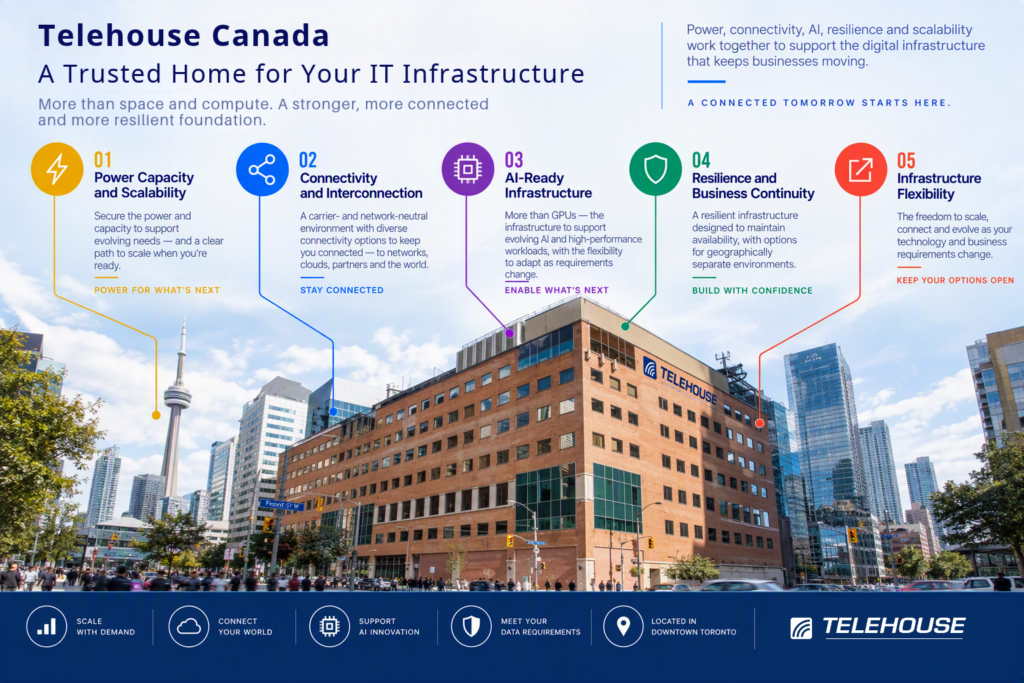
1. Power Capacity and Scalability
AI and other compute-intensive applications are changing infrastructure requirements, making power availability and capacity planning increasingly important considerations for data centre strategies.
But this isn’t only an issue for organizations deploying large-scale AI infrastructure. As new applications, higher-density computing and changing IT architectures are introduced, businesses need to understand whether their infrastructure can scale with evolving requirements.
When assessing a data centre or colocation provider, organizations should consider:
- available and planned power capacity;
- support for evolving infrastructure densities;
- cooling capabilities;
- scalability within the facility;
- power quality and infrastructure redundancy; and
- the ability to accommodate future growth.
For higher-density environments, power quality can become an important consideration alongside power capacity, as more dynamic compute workloads can place different demands on supporting electrical infrastructure.
Availability is also only part of the equation. Organizations should consider how quickly additional capacity can realistically be delivered. Where power and broader infrastructure constraints affect deployment timelines, planning ahead and securing capacity before it becomes an immediate requirement can help preserve flexibility.
Key question for 2027: Can your data centre infrastructure scale as your power, cooling and capacity requirements change?
2. Connectivity and Interconnection
Connectivity should be a core part of a strategy, not something considered after the infrastructure has already been deployed.
Modern IT environments rarely operate in isolation. Applications, data and workloads increasingly move between data centres, cloud platforms, networks, offices, customers and partners.
As infrastructure becomes more distributed and data-intensive workloads continue to grow, the ability to move data efficiently between these environments becomes increasingly important.
AI can add another dimension to this challenge as organizations move growing volumes of data between compute environments, applications and platforms. That makes the connectivity ecosystem surrounding a data centre an important consideration.
A carrier- and network-neutral data centre environment can give organizations greater choice over how they connect their infrastructure. Instead of depending on a single network provider, businesses can evaluate providers and connectivity options based on their individual performance, redundancy and business requirements.
When evaluating connectivity for 2027, consider:
- carrier and network choice;
- diverse connectivity options;
- cloud connectivity;
- data centre interconnection;
- access to Internet exchanges and peering ecosystems;
- scalable fibre connectivity; and
- physical and network route diversity.
As infrastructure becomes more distributed, where compute is located and how efficiently it can connect to the rest of the digital ecosystem should increasingly be considered together.
Key question for 2027: Does your infrastructure give you enough connectivity choice and diversity to adapt as your network, cloud and workload strategy evolves?
3. AI-Ready Data Centre Infrastructure
What does AI-ready infrastructure actually mean?
AI-ready infrastructure is about more than GPUs.
It is the combination of compute, power, cooling, connectivity, capacity and resilience required to support evolving AI and high-performance workloads.
Not every business will need to operate large AI training environments. However, organizations increasingly need to consider how AI adoption could affect their broader infrastructure architecture.
That may include higher compute densities, greater data movement between environments, changing latency requirements, connectivity to cloud and AI platforms, and increased power or cooling requirements.
Different workloads can place different demands on infrastructure. AI training, inference and traditional enterprise applications may have varying requirements across power, cooling and connectivity. As densities increase, liquid and hybrid cooling approaches may also become more relevant depending on the workload and facility environment.
Rather than trying to predict exactly how their AI environment will look several years from now, businesses can focus on building an infrastructure foundation that gives them flexibility.
Key question for 2027: Will your current infrastructure give you the flexibility to introduce more demanding AI and compute workloads without completely rethinking your data centre strategy?
4. Resilience and Business Continuity
As organizations depend on increasingly interconnected digital environments, infrastructure resilience becomes even more important.
A resilient data centre strategy considers more than individual pieces of equipment. It examines how the broader infrastructure environment is designed to maintain availability and reduce single points of failure. That includes considerations such as:
- redundant power infrastructure;
- resilient cooling infrastructure;
- network and route diversity;
- multiple connectivity options;
- backup and disaster recovery strategies;
- operational support; and
- geographically appropriate infrastructure.
Organizations should also think about resilience beyond a single location. For businesses operating critical digital infrastructure, having geographically separate environments can form part of a broader business continuity or disaster recovery strategy.
Resilience should also extend beyond the facility itself. Organizations should consider dependencies across network routes, connectivity providers, cloud environments and other critical components that their applications rely on.
Key question for 2027: If one component of your infrastructure becomes unavailable, do you have the redundancy and connectivity required to maintain critical operations running 24/7?
5. Infrastructure Flexibility
Perhaps the most important infrastructure capability for 2027 isn’t a particular technology.
It’s flexibility.
Technology architectures continue to evolve across colocation, cloud, AI and enterprise IT. The infrastructure model that works for an organization today may need to accommodate very different workloads, densities and connectivity requirements tomorrow.
Locking an organization into an environment that meets immediate requirements but leaves little room to adapt can create challenges later. Infrastructure flexibility can include:
- Scalable capacity: the ability to expand space, power or connectivity as requirements grow.
- Density flexibility: the ability to accommodate evolving power and cooling requirements as compute densities change.
- Network choice: access to multiple carriers and connectivity providers.
- Hybrid infrastructure: the ability to connect colocated infrastructure with cloud platforms and other IT environments.
- Interconnection: efficient connections between networks, partners, platforms and infrastructure locations.
- Operational flexibility: access to support that helps organizations manage infrastructure without requiring personnel to be physically present for every task.
The objective isn’t to predict every technology change. It is to build an infrastructure foundation that doesn’t unnecessarily limit which technologies or architectures the organization can adopt next.
Key question for 2027: Will the infrastructure decisions you make today leave enough options open for what your business may need tomorrow?
What Should Businesses Look for in a Data Centre Provider in 2027?
Organizations evaluating a data centre or colocation provider should look beyond rack space and price. Five areas deserve particular attention:
- Power: Is sufficient capacity available for current and future requirements, and what is the realistic path and timeline for accessing additional capacity?
- Connectivity: Can you choose from multiple carriers, networks and connectivity options, with appropriate fibre capacity and route diversity?
- Scalability: Can your deployment expand across space, power and cooling without requiring another major infrastructure migration?
- Resilience: How is availability supported across power, cooling, network and facility infrastructure?
- Location: Does the data centre put your infrastructure close to the networks, cloud platforms, partners and users important to your business?
For many organizations, these capabilities will determine how effectively their infrastructure can respond to changing business and technology requirements.
Why Location Still Matters in an Increasingly Distributed World?
Cloud computing has made infrastructure more distributed, but physical location still matters.
Data centre location can influence network access, connectivity options, latency, operational accessibility and proximity to major business markets. Location can also form part of broader data residency, sovereignty and regulatory considerations, particularly for organizations evaluating where critical data and workloads should be stored and processed.
At the same time, a location’s value is increasingly connected to the infrastructure surrounding it. Access to power needs to be considered alongside connectivity, fibre availability and access to the networks, cloud platforms and digital ecosystems an organization depends on.
For organizations operating in Canada, downtown Toronto is an established connectivity market, making location an important consideration when evaluating colocation and interconnection strategies.
Telehouse Canada’s data centres in downtown Toronto give organizations access to colocation infrastructure within one of Canada’s important digital connectivity environments. This combination of space, power and connectivity can help businesses establish infrastructure designed to support current requirements while maintaining options for future growth.
What Canadian Businesses Should Consider When Planning Data Centre Infrastructure?
Canada is participating in the same global infrastructure transformation, but organizations here also need to consider their own requirements around geography, connectivity, resilience, regulatory considerations and proximity to customers and business centres.
Data sovereignty is also becoming a greater consideration as organizations evaluate where their data and workloads should reside and how their infrastructure connects across cloud, colocation and other environments. For organizations with specific data residency, security or regulatory requirements, understanding where data is stored and processed, and which jurisdictions may apply, should form part of the broader infrastructure strategy.
For enterprises developing their 2027 infrastructure roadmaps, this creates an opportunity to revisit some fundamental questions:
- Do we have enough power and capacity to support growth?
- Can our current environment accommodate higher-density workloads if required?
- Can our power and cooling infrastructure evolve with our compute requirements?
- Do we have sufficient network-provider choice and route diversity?
- How easily can our infrastructure connect to cloud and other environments?
- Do our infrastructure and data location decisions align with security, data residency and regulatory requirements?
- Are resilience and disaster recovery built into the architecture?
- Can we expand without undertaking another major infrastructure migration?
- Is our infrastructure located close to the networks, partners and users that matter to the business?
These questions extend well beyond the traditional conversation about racks and square footage. They are increasingly questions about business agility.
Planning Your 2027 Data Centre Strategy?
Whether you’re expanding your infrastructure footprint, strengthening network connectivity, evaluating colocation or preparing for new AI and higher-density workloads, your strategy starts with the right foundation.
Telehouse Canada provides secure colocation, connectivity and data centre infrastructure in downtown Toronto, helping businesses build for today’s requirements while preparing for what’s next.
Explore our data centres or contact us to discuss your infrastructure requirements and book a data centre tour.