


 Colocation
 Data Centre Migration
 Remote Hands and Eyes
 Cross Connect
 Meet-Me Room (MMR)
 Access To Peering
 Cloud Connectivity
 Dedicated Internet Access
 Data Centre Interconnect
 AI Exchange
 151 Front Street West Data Centre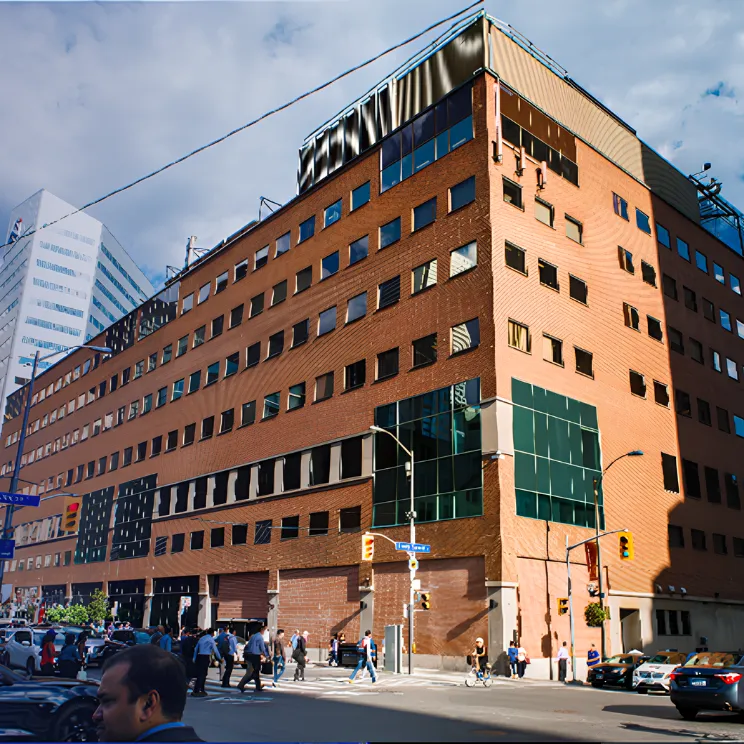
 About Us
 Careers
 Compliance
 Management Team
 Sustainablity
 Customer Portal
Most conversations about AI infrastructure start with compute: which GPUs to use, how many are needed, and how quickly they can be deployed. However, as organizations deploy increasingly powerful AI infrastructure, compute is only part of the equation. Heat has become one of the industry’s biggest constraints.
Over the past few years, that challenge has increasingly influenced where AI infrastructure is deployed. As rack densities climbed, many new AI deployments moved beyond urban data centres. New capacity was developed in locations selected for lower land costs, available grid capacity and the physical space needed to accommodate the mechanical infrastructure required for high-density cooling.
This approach addressed the immediate cooling challenge, but it introduced another trade-off that became increasingly important. Distance adds latency, and for many of today’s AI inference workloads, that can directly affect application performance and the user experience.
Direct-to-chip liquid cooling changes that equation. By removing heat directly from high-power components such as CPUs and GPUs, it captures heat far more efficiently than air cooling alone, reducing reliance on room-level cooling and enabling higher rack power densities. This makes it possible to support AI and HPC workloads in facilities where traditional air-cooling approaches would struggle to accommodate increasing compute densities. For organizations deploying AI workloads near their end users, direct-to-chip cooling expands where high-density infrastructure can be deployed.
Why Did AI Push Data Centres Out of Cities in the First Place?
A significant number of data centres in operation today were purpose-built for traditional workloads, with halls designed around rack densities of roughly 5 to 10 kW. While air cooling has handled that comfortably for decades, it becomes increasingly difficult to scale as AI workloads drive rack densities higher.
AI accelerators changed that. A single accelerator can draw well over a kW under load, and a fully populated rack of them produces more heat than an entire row of traditional servers.
Air, however, can only remove so much heat before the approach stops scaling.
The conventional response was to build larger facilities. Rather than changing how heat was removed, operators expanded air handling capacity, mechanical infrastructure, and floor space to accommodate rising rack densities.
However, space is exactly what urban facilities lack. As a result, many high-density AI data centres have been built farther from the cities and businesses they serve. Power availability has also played a significant role in where this infrastructure is deployed. Historically, large-scale AI and hyperscale builds prioritized sites with abundant power, available land, and natural cooling resources, while proximity to network ecosystems and end users was often a secondary consideration. Today, as AI adoption matures and real-time inferencing takes off, latency and data proximity have become just as critical as power.
But siting is only part of the challenge. Even in facilities with sufficient power and connectivity, managing the heat generated by high-density AI infrastructure remains a significant constraint.
How is Direct-to-Chip Cooling Different?
Direct-to-chip cooling, also called direct liquid cooling, delivers coolant directly to high-power components within a server, such as CPUs and GPUs, rather than relying primarily on cooling the surrounding air.
A liquid-cold plate is mounted directly onto the CPU or GPU in place of a conventional heatsink. Coolant flows through the plate, absorbs heat by conduction, and carries it out of the server through sealed hoses.
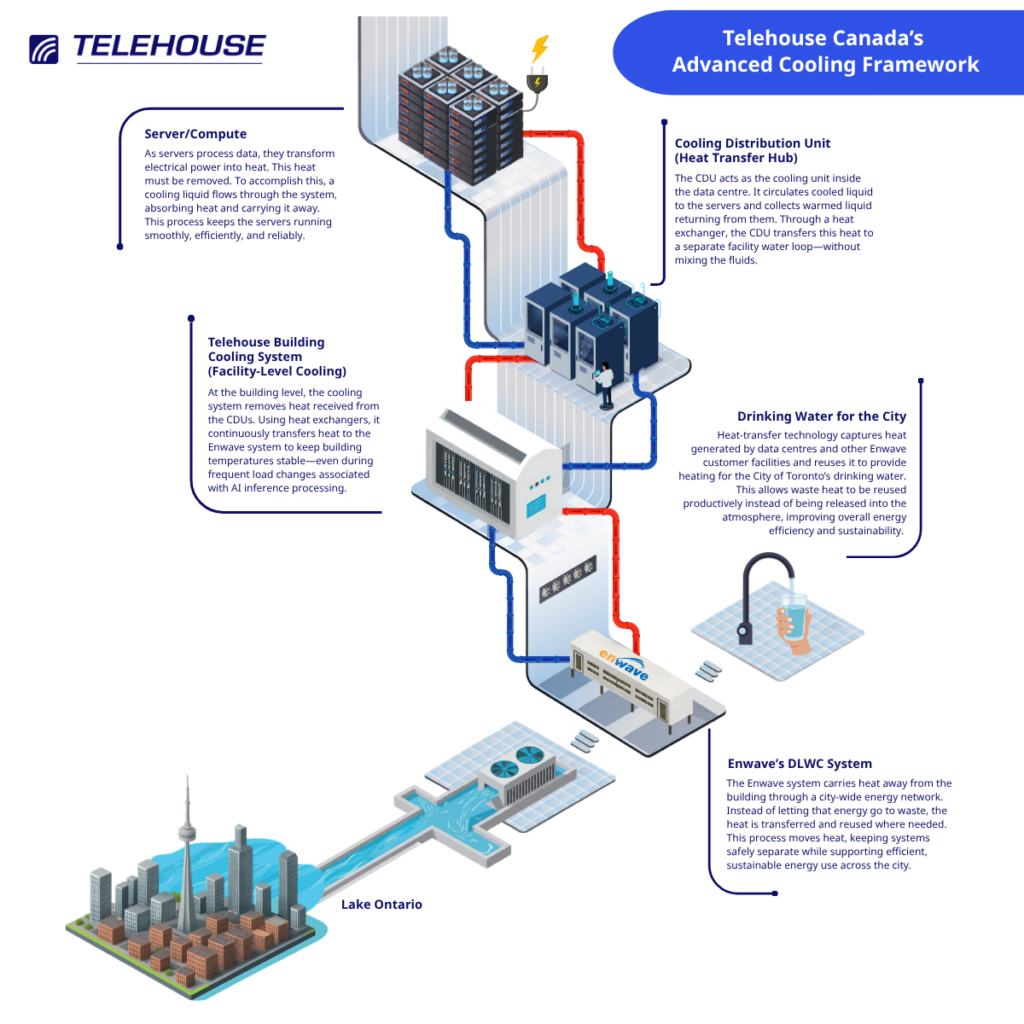
Those hoses connect to manifolds at the rack, which feed a coolant distribution unit. Heat is typically transferred through a coolant distribution unit (CDU). Within the CDU, a heat exchanger isolates the server cooling loop from the facility water loop. The facility loop then removes the heat through the building’s cooling infrastructure.
The advantage comes down to physics. Liquid can transfer significantly more heat than air within a given volume, allowing a relatively modest coolant flow to remove heat that would otherwise require large volumes of moving air.
Modern AI clusters can drive rack power densities well beyond the capabilities of many traditional air-cooled environments. By capturing and transporting heat within a controlled liquid loop, direct-to-chip cooling can support these higher-density deployments, improve cooling efficiency, and reduce dependence on high-volume air flow. It also creates opportunities for heat reuse that are more difficult to achieve with traditional air-cooling systems.
What Happens to the Heat Afterward?
This is where the difference between air and liquid becomes most significant.
Air cooling disperses heat throughout the data hall before it is removed by the facility’s cooling infrastructure. While heat recovery is still possible, the lower temperature and dispersed nature of the heat can make reuse more challenging and less efficient than with liquid-cooled systems. Liquid cooling captures heat rather than dispersing it. Because the heat remains within a closed loop, it can be transferred and reused in ways that would otherwise be more difficult to achieve.
The wider opportunity is what this makes possible on a city scale. Dense urban environments often have significant and ongoing demand for heating in residential, commercial, and district energy systems, while AI infrastructure generates substantial quantities of waste heat. Capturing that heat in liquid form can create new opportunities for heat recovery and reuse.
Facilities located farther from urban centres generate the same heat but often have fewer nearby opportunities to recover and reuse it. While proximity to users, networks, and data remains the primary driver for many urban AI deployments, liquid cooling also creates opportunities to capture and reuse waste heat, potentially generating additional sustainability benefits for surrounding communities.
Telehouse Canada recently completed a major infrastructure upgrade that includes direct-to-chip cooling technology to support high-density AI deployments within its urban data centre campus.
Through this process, up to 80 per cent of heat can be removed directly from high-power server components, improving energy efficiency at the facility.
As a result, reliance on power-intensive computer room air conditioners and server fans is reduced, lowering overall energy consumption and supporting a more sustainable cooling model. The direct liquid cooling system transfers heat from the server components to a cooling distribution unit, where it is carried away via a dedicated coolant loop.
This heat is then transferred to Enwave’s closed-loop district energy system, where it is captured and repurposed through a fully isolated process to help heat Toronto’s municipal drinking water rather than being released into the atmosphere. This process also improves Telehouse Canada’s Power Usage Effectiveness (PUE). In addition, the system removes reliance on chillers during normal operations, reducing the need for evaporative cooling and water usage, and further improving the facility’s Water Usage Effectiveness (WUE).
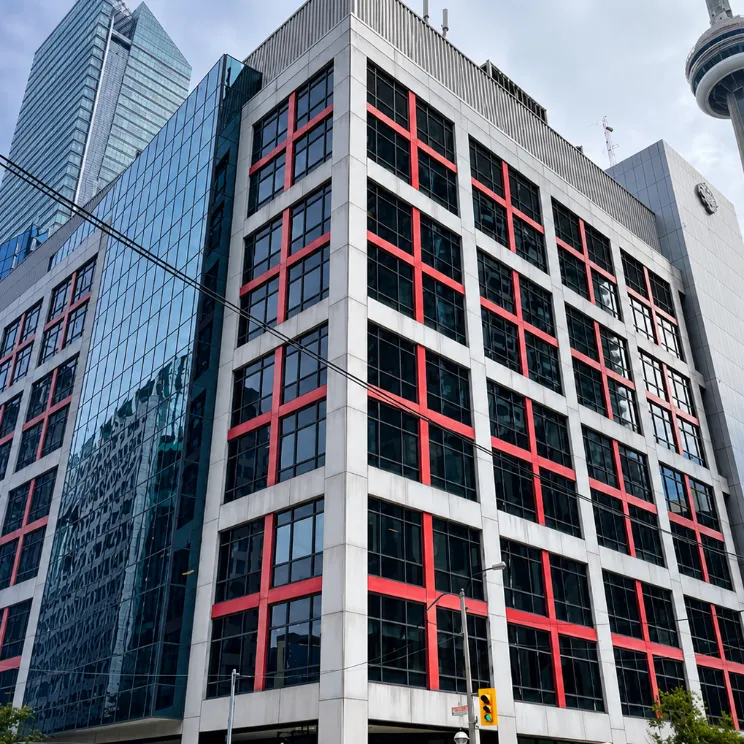
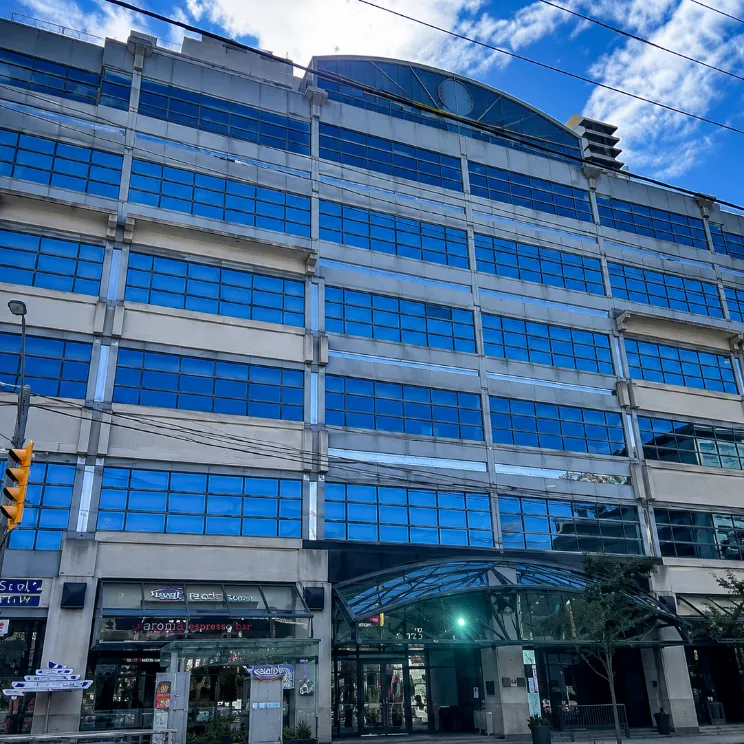
Telehouse Canada’s three Toronto data centres offer access to one of the world’s densest ecosystems of carriers, ISPs, internet exchanges and cloud providers, including the Toronto Internet Exchange (TorIX) and Canada’s Internet Exchanges (CANIX). Combined with direct-to-chip cooling, this allows organizations to deploy high-density AI infrastructure without sacrificing connectivity.
For years, the requirements of high-density AI infrastructure made deployment outside urban centres the more practical option. Direct-to-chip cooling is helping change that equation by addressing one of the biggest constraints: heat.
By enabling higher-density deployments in urban facilities, the technology also creates new opportunities to recover and reuse heat while keeping compute closer to end users and networks that depend on it.
To learn more Telehouse Canada’s AI-ready infrastructure and direct-to-chip cooling capabilities, contact our team or book a tour of one of our Toronto facilities.